 info@rusticfrontiers.com
  +975 17692115/77692115
“The journey from Bumthang to Mongar, over the 4,000 meters Phrumsengla pass, is breathtakingly scenic”.
The journey from Bumthang to Mongar, crossing over the 4,000 meters high Phrumsengla pass, is scenically spectacular. Mongar marks the beginning of eastern Bhutan. The second largest town in the sub-tropical east, Mongar is built high on a gently sloping hillside.
Mongar Dzong

Mongar is the fastest-growing Dzongkhag in eastern Bhutan, with a regional hospital and a thriving economy. The area is famous for its lemon grass, used to produce essential oil, and is home to a hydropower plant on the Kuri chhu river. The western part of Mongar includes part of the Phrumsengla National Park, while the north-eastern section contains part of the Bumdeling Wildlife Sanctuary, including the County of Sher Muhung.
Historically, Mongar was known as the stronghold of the Zhongarps, producing some of Bhutan’s finest administrators. Their descendants continue to play an active role in the country’s political scene today.
Zhongar Dzong
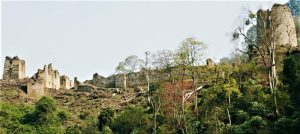 The ruin of Zhongar Dzong endures to this day as a testimony to the skill of its builders, most notably the renowned master craftsman, Zowo Balep. It is located on a hilltop overlooking the village of Thridangbi and is visible as one descends to Lingmithang from the highway. Built in the 17th century, the Dzong is believed to have been built at a site where the master architect Zow Balep saw a white bowl. Embedded inside is a life frozen in time, a wealth of history that can be still recounted orally by those who also heard it from their grandparents. A visit to the ruins can be a memorable experience and will give you a sense of the medieval Bhutanese administration.